|
[background.]
|
|
i am an assistant professor in the computer
science and engineering department at nyu poly, a
member of the game innovation lab, and part of
hemisphere games, creators of
osmos.
prior to my appointment at nyu i was an assistant professor in the
computer science department
of the rutgers university
school of arts and sciences,
and a postdoctoral researcher with the computer graphics group
(CG),
at the technische
universitaet berlin's electrical
engineering and computer science department, where i was teaching courses on
introductory and advanced computer graphics
and game programming and design.
my research interests are
generally related to game design, computer graphics, human perception, geometric modeling, and physically-based modeling.
currently, my research is directed towards
interactive geometric and physical shape modeling, animation and editing,
human perception of shape and motion, and (video) game design. more on my background can be found in my cv, selected projects can be viewed below.
|
|
|
[publications.]
|
|
|
Adrian Secord, Jingwan Lu, Adam Finkelstein, Manish Singh, and Andrew Nealen
|
|
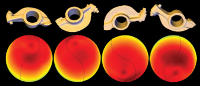
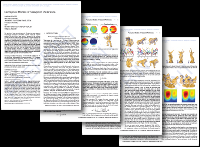
Perceptual models of viewpoint preference
|
|
|
The question of what are good views of a 3D object has been addressed by numerous researchers in perception, computer vision, and computer graphics. This has led to a large variety of measures for the goodness of views as well as some special-case viewpoint selection algorithms. In this article, we leverage the results of a large user study to optimize the parameters of a general model for viewpoint goodness, such that the fitted model can predict people's preferred views for a broad range of objects. Our model is represented as a combination of attributes known to be important for view selection, such as projected model area and silhouette length. Moreover, this framework can easily incorporate new attributes in the future, based on the data from our existing study. We demonstrate our combined goodness measure in a number of applications, such as automatically selecting a good set of representative views, optimizing camera orbits to pass through good views and avoid bad views, and trackball controls that gently guide the viewer towards better views.
|
|
ACM Transactions on Graphics 30(5), October 2011.
|
|
 project page project page
|
|
|
|
|
|
Andy Nealen, Adam Saltsman, and Eddy Boxerman
|
|
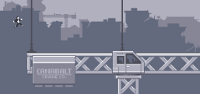
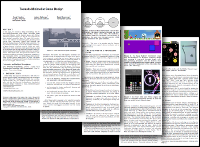
Towards Minimalist Game Design
|
|
|
In this paper, we describe a design methodology that we
have termed Minimalist Game Design. Minimalist games
have small rulesets, narrow decision spaces, and abstract
audiovisual representations, yet they do not compromise on
depth of play or possibility space. We begin with a motivation for
and definition of minimalist games, including terms such as "rules," "mechanics," "control," and "interface,"
and illustrate the importance of artificial design constraints. Using a number of examples, we show the
strengths of minimalist game elements in systems, controls, visuals, and audio.
Adhering to these constraints, these games feature a small set of mechanics and one core mechanic, while
still being sufficiently deep and allowing for player exploration and performance. This depth comes
from procedural methods, combinatorial complexity, probability, obfuscation, challenge, or
any combination thereof. Our methodology embraces principles of holistic design, where there
is no "filler," and where every element of the game contributes to the play
experience in some meaningful, deliberate way.
|
|
in proceedings of foundations of digital games 2011
|
|
preprint (pdf)
|
|
|
|

|
|
Kenshi Takayama, Olga Sorkine, Andrew Nealen and Takeo Igarashi
|
|
Volumetric Modeling with Diffusion Surfaces
|
|
|
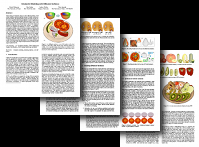
The modeling of volumetric objects is still a difficult problem. Solid texture synthesis methods enable the design of volumes with homogeneous textures, but global features such as smoothly varying colors seen in vegetables and fruits are difficult to model. In this paper, we propose a representation called diffusion surfaces (DSs) to enable modeling such objects. DSs consist of 3D surfaces with colors defined on both sides, such that the interior colors in the volume are obtained by diffusing colors from nearby surfaces. A straightforward way to compute color diffusion is to solve a volumetric Poisson equation with the colors of the DSs as boundary conditions, but it requires expensive volumetric meshing which is not appropriate for interactive modeling. We therefore propose to interpolate colors only locally at user-defined cross-sections using a modified version of the positive mean value coordinates algorithm to avoid volumetric meshing. DSs are generally applicable to model many different kinds of objects with internal structures. As a case study, we present a simple sketch-based interface for modeling objects with rotational symmetries that can also generate random variations of models. We demonstrate the effectiveness of our approach through various DSs models with simple non-photorealistic rendering techniques enabled by DSs.
|
|
ACM Transactions on Graphics Vol.29, Issue 5 (SIGGRAPH Asia 2010)
|
|
preprint (16.1mb, pdf)
|
|
 youtube video youtube video
|
|
project page
|
|
|
|
|
|
Péter Borosán, Reid Howard, Shaoting Zhang and Andrew Nealen
|
|
Hybrid Mesh Editing
|
|
|
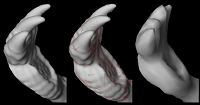
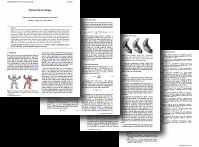
Surface-based deformation and cage-based deformation are two popular shape editing paradigms. Surface-based
methods are easy to use and produce high-quality results by preserving differential properties of the surface
mesh, but are limited by their computational requirements. Cage-based methods produce results quickly but at
the expense of usability and realism, and typically require manual construction of suitable cages. We introduce
a hybrid approach that combines the two methods. The user can perform edits on an automatically-generated
simplified version of an input shape using As-rigid-as-possible surface modeling, and the edit is propagated to the
original shape by a precomputed space deformation based on Mean value coordinates. We analyze deformation
quality and running time for a variety of cage sizes. High-quality results are obtained for meshes on the order of
100K vertices at interactive rates by using cages with ~5% of the vertices of the original shape.
|
|
in
proceedings of EUROGRAPHICS 2010.
|
|
preprint (pdf)
|
|
|
|

|
|
Shaoting Zhang, Andrew Nealen and Dimitris Metaxas
|
|
Skeleton Based As-Rigid-As-Possible Volume Modeling
|
|
|
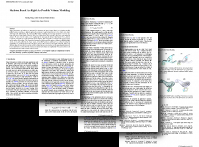
Shape deformation and editing are important for animation and game design. Based on as-rigid-as-possible
(ARAP) surface modeling, an efficient approach is proposed to approximately preserve the volume of an object
with large-scale deformations. The classical ARAP surface modeling uses two-stage iterations to recover rotations
and preserve edge lengths. However, there is no volume preserving constraint, which may cause undesired
artifacts. We show that the volume can be roughly kept by leveraging the skeleton information. First a skeleton
is selected, and points are evenly generated on the skeleton. Then each point is correlated with several vertices
on the surface of the object. The connectivity between the skeleton and the surface is defined as skeleton edges,
which can be easily added into the linear system of the ARAP method as additional rows without breaking the
manifoldness or sacrificing speed. Since this linear system is able to preserve the lengths of both the surface and
skeleton edges, the area of cross sections and the volume between cross sections can be approximately preserved.
|
|
in
proceedings of EUROGRAPHICS 2010.
|
|
preprint (pdf)
|
|
|
|
|
|
Andrew Nealen, Justus Pett, Marc Alexa and Takeo Igarashi
|
|
GridMesh: Fast and High Quality 2D Mesh Generation for Interactive 3D Shape Modeling
|
|
|
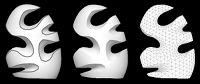
In this paper we present an algorithm
for watertight meshing of closed, sketched curves.
The sketch is resampled as a piecewise linear (PWL)
curve and placed onto a triangular grid. A small
boundary (seed) that describes a closed path along
grid points is placed inside the sketch and grown
until it resembles the sketch. Vertices of the evolved
grid boundary are projected onto the stroke to establish
a bijective, ordered mapping. Finally, valences
along the boundary are optimized while retaining
the previously established mapping. The resulting
mesh patch can be duplicated, stitched and inflated
to generate a new shape, or used to fill a hole in an existing
shape. We have implemented our algorithm in
FiberMesh, an interactive sketch based interface
for designing freeform surfaces, where it is used for
the all mesh generation processes. The triangulation
generated with our algorithm improves the quality
of the model by reducing the number of irregular
vertices, while running at real time rates.
|
|
in
IEEE International Conference on Shape Modeling and Applications, 2009 (SMI 2009), 155-162, 2009.
|
|
preprint (0.99mb, pdf)
|
|
|
|
|
|
Johannes
Zimmermann, Andrew Nealen and Marc Alexa
|
|
Sketching
Contours
|
|
|
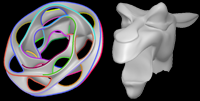
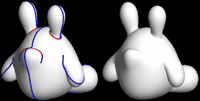
We
introduce an over-sketching interface for feature-preserving surface mesh
editing. The user sketches a stroke that is the suggested position of part of a
silhouette of the displayed surface. The system then segments all image-space
silhouettes of the pro jected surface, identifies among all silhouette segments
the best matching part, derives vertices in the surface mesh corresponding to
the silhouette part, selects a sub-region of the mesh to be modified, and feeds
appropriately modified vertex positions together with the sub-mesh into a mesh
deformation tool. The overall algorithm has been designed to enable interactive
modification of the surface - yielding a surface editing system that comes
close to the experience of sketching 3D models on paper.
|
|
in Computers & Graphics, Vol. 32, issue 3, pages 486-499, 2008
|
|
preprint (6.45mb, pdf)
|
|
youtube video
|
|
|
|
|
|
Andrew
Nealen, Takeo Igarashi, Olga Sorkine and Marc Alexa
|
|
FiberMesh:
Designing Freeform Surfaces with 3D Curves
|
|
|
This
paper presents an interface for designing freeform surfaces with a collection
of 3D curves. The user first creates a rough 3D model by using a sketching
interface. Unlike previous sketching systems, the user-drawn strokes stay on
the model surface and serve as handles for controlling the geometry. The user
can add, remove, and deform these control curves easily, as if working with a
2D line drawing. The curves can have arbitrary topology; they need not be
connected to each other. For a given set of curves, the system automatically
constructs a smooth surface embedding by applying functional optimization. Our
system provides realtime algorithms for both control curve deformation and the
subsequent surface optimization. We show that one can create sophisticated
models using this system, which have not yet been seen in previous sketching or
functional optimization systems.
|
|
in
proceedings of ACM SIGGRAPH
2007, article No. 41
|
|
paper (12.1mb, pdf)
|
|
supplemental tech report (207kb, pdf)
|
|
 powerpoint presentation
(9.6mb) powerpoint presentation
(9.6mb)
|
|
youtube video
|
|
quicktime video (52.2mb) |
raccoon (25.7mb) |
thumb (9.9mb)
|
|
 java application java application
|
|
user demos:
 blender user,
zbrush user blender user,
zbrush user
|
|
|
|
|
|
Johannes
Zimmermann, Andrew Nealen and Marc Alexa
|
|
SilSketch:
Automated Sketch-Based Editing of Surface Meshes
|
|
|
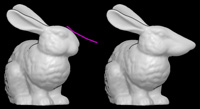
We
introduce an over-sketching interface for feature-preserving surface mesh
editing. The user sketches a stroke that is the suggested position of part of a
silhouette of the displayed surface. The system then segments all image-space
silhouettes of the projected surface, identifies among all silhouette segments
the best matching part, derives vertices in the surface mesh corresponding to
the silhouette part, selects a sub-region of the mesh to be modified, and feeds
appropriately modified vertex positions together with the sub-mesh into a mesh
deformation tool. The overall algorithm has been designed to enable interactive
modification of the surface -- yielding a surface editing system that comes
close to the experience of sketching 3D models on paper.
|
|
in
proceedings of the Workshop on
Sketch-Based Interfaces and Modeling, pages 23-30, 2007
|
|
paper (2.4mb, pdf)
|
|
youtube video
|
|
video (5.8mb)
|
|
|
|
|
|
Andrew
Nealen, Takeo Igarashi, Olga Sorkine and Marc Alexa
|
|
Laplacian
Mesh Optimization
|
|
|
We
introduce a framework for triangle shape optimization and feature preserving
smoothing of triangular meshes that is guided by the vertex Laplacians,
specifically, the uniformly weighted Laplacian and the discrete mean curvature
normal. Vertices are relocated so that they approximate prescribed Laplacians
and positions in a weighted least-squares sense; the resulting linear system
leads to an efficient, non-iterative solution. We provide different weighting
schemes and demonstrate the effectiveness of the framework on a number of
detailed and highly irregular meshes; our technique successfully improves the
quality of the triangulation while remaining faithful to the original surface
geometry, and it is also capable of smoothing the surface while preserving
geometric features.
|
|
in
proceedings of ACM
GRAPHITE 2006, pages 381-389
|
|
paper, preprint (14.5mb,
pdf)
|
|
powerpoint presentation
(11.5mb)
|
|
|
|
|
|
Andrew
Nealen, Olga Sorkine, Marc Alexa and Daniel Cohen-Or
|
|
A
Sketch-Based Interface for Detail-Preserving Mesh Editing
|
|
|
In this
paper we present a method for the intuitive editing of surface meshes by means
of view-dependent sketching. In most existing shape deformation work, editing
is carried out by selecting and moving a handle, usually a set of
vertices. Our system lets the user easily determine the handle, either by
silhouette selection and cropping, or by sketching directly onto the surface.
Subsequently, an edit is carried out by sketching a new, view-dependent handle
position or by indirectly influencing differential properties along the sketch.
Combined, these editing and handle metaphors greatly simplify otherwise complex
shape modeling tasks. We come to the conclusion that sketching a shape
is inverse NPR. Consequently, we design a sketch-based modeling
interface using silhouettes and sketches as input, and producing contours, or
suggestive contours, and ridges/ravines. The user can sketch a curve, and the
system adapts the shape so that the sketch becomes a feature line on the model,
while preserving global and local geometry as much as possible [Sorkine et. al
2004]. As the requested properties of the sketch cannot or should not always be
accommodated exactly, users only suggest feature lines.
|
|
in
proceedings of ACM SIGGRAPH
2005, pages 1142-1147
|
|
paper (10.4mb, pdf)
|
|
powerpoint presentation
(8.9mb)
|
|
video (66.6mb)
|
|
|
|
|
|
Andrew
Nealen, Matthias Müller, Richard Keiser, Eddy Boxerman and Mark Carlson
|
|
Physically
Based Deformable Models in Computer Graphics
|
|
|
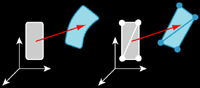
Physically
based deformable models have been widely embraced by the Computer Graphics
community. Many problems outlined in a previous survey by Gibson and Mirtich
[GM97] have been addressed, thereby making these models interesting and useful
for both offline and real-time applications, such as motion pictures and video
games. In this paper, we present the most significant contributions of the past
decade, which produce such impressive and perceivably realistic animations and
simulations: finite element/difference/volume methods, mass-spring systems,
meshfree methods, coupled particle systems and reduced deformable models based
on modal analysis. For completeness, we also make a connection to the
simulation of other continua, such as fluids, gases and melting objects. Since
time integration is inherent to all simulated phenomena, the general notion of
time discretization is treated separately, while specifics are left to the
respective models. Finally, we discuss areas of application, such as
elastoplastic deformation and fracture, cloth and hair animation, virtual
surgery simulation, interactive entertainment and fluid/smoke animation, and
also suggest areas for future research.
|
|
Computer
Graphics Forum, Vol. 25, issue 4, pages 809-836 (previously published as a
Eurographics 2005 state-of-the-art report)
|
|
paper, preprint (11.5mb,
pdf)
|
|
|
|
|
|
Anders
Adamson, Marc Alexa and Andrew Nealen
|
|
Adaptive
Sampling of Intersectable Models Exploiting Image and Object-space Coherence
|
|
|
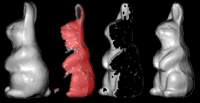
We
present a sampling strategy and rendering framework for intersect-able models,
whose surface is implicitly defined by a black box intersection test that
provides the location and normal of the closest intersection of a ray with the
surface. To speed up image generation despite potentially slow intersection
tests, our method exploits spatial coherence by adjusting the sampling
resolution in image space to the surface variation in object space. The result
is a set of small, view-dependent bilinear surface approximations, which are
rendered as quads using conventional graphics hardware. The advantage of this
temporary rendering representation is two-fold: First, rendering is performed
on the GPU, leaving CPU time for ray intersection computation. Second, bilinear
surface approximations are derived from the geometry and can be reused in other
views. Here, graphics hardware is exploited to determine the subset of image
space in need of re-sampling. We demonstrate our system by ray casting an
implicit surface defined from point samples, for which current ray-surface
intersection computations are usually too slow to generate images at
interactive rates.
|
|
in
proceedings of the
ACM SIGGRAPH 2005 Symposium on Interactive 3D Graphics and Games, pages
171-178
|
|
paper, preprint (7.33mb,
pdf)
|
|
|
|
|
|
Matthias
Müller, Richard Keiser, Andrew Nealen, Mark Pauly, Markus Gross, Marc
Alexa
|
|
Point
Based Animation of Elastic, Plastic and Melting Objects
|
|
|
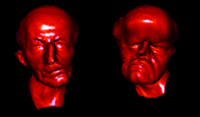
We
present a method for modeling and animating a wide spectrum of volumetric
objects, with material properties anywhere in the range from stiff elastic to
highly plastic. Both the volume and the surface representation are point based,
which allows arbitrarily large deviations form the original shape. In contrast
to previous point based elasticity in computer graphics, our physical model is
derived from continuum mechanics, which allows the specification of common
material properties such as Young's Modulus and Poisson's Ratio. In each step,
we compute the spatial derivatives of the discrete displacement field using a
Moving Least Squares (MLS) procedure. From these derivatives we obtain strains,
stresses and elastic forces at each simulated point. We demonstrate how to
solve the equations of motion based on these forces, with both explicit and
implicit integration schemes. In addition, we propose techniques for modeling
and animating a point-sampled surface that dynamically adapts to deformations
of the underlying volumetric model.
|
|
in
proceedings of the ACM
SIGGRAPH/Eurographics Symposium on Computer Animation 2004, pages
141-151
|
|
paper, preprint (9.0mb,
pdf)
|
|
powerpoint presentation
(2.0mb)
|
|
video (16.9mb)
|
|
|
|
|
|
Andrew
Nealen and Marc Alexa
|
|
Fast and
High Quality Overlap Repair for Patch-Based Texture Synthesis
|
|
|
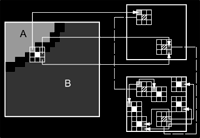
Patch-based
texture synthesis has proven to produce high quality textures faster than
pixel-based approaches. Previous algorithms differ in how the regions of
overlap between neighboring patches are treated. We present an approach that
produces higher quality overlap regions than simple blending of patches or
computing good boundaries, however, that is faster than re-synthesizing invalid
pixels using a classical per-pixel synthesis algorithm: we use a k-nearest
neighbor (knn) data structure, obtained from the input texture in a
precomputation step. Results from our implementation show that the algorithm
produces high-quality textures, where the time complexity of the synthesis
stage is linear in the number of re-synthesized pixels and, therefore, scales
well with the size of the input texture.
|
|
in
proceedings of Computer
Graphics International 2004, pages 582-585
|
|
paper, preprint (1.2mb,
pdf)
|
|
powerpoint presentation
(4.0mb)
|
|
|
|
|
|
Andrew
Nealen and Marc Alexa
|
|
Hybrid
Texture Synthesis
|
|
|
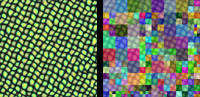
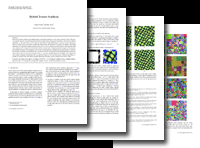
Patch-based
texture synthesis algorithms produce reasonable results for a wide variety of
texture classes. They preserve global structure, but often introduce unwanted
visual artifacts along patch boundaries. Pixel-based synthesis algorithms, on
the other hand, tend to blur out small objects while maintaining a consistent
texture impression, which in return doesn't necessarily resemble the input
texture. In this paper, we propose an adaptive and hybrid algorithm. Our
algorithm adaptively splits patches so as to use as large as possible patches
while staying within a user-defined error tolerance for the mismatch in the
overlap region. Using large patches improves the reproduction of global
structure. The remaining errors in the overlap regions are eliminated using
pixel-based re-synthesis. We introduce an optimized ordering for the
re-synthesis of these erroneous pixels using morphological operators, which
ensures that every pixel has enough valid (i.e., error-free) neighboring
pixels. Examples and comparisons with existing techniques demonstrate that our
approach improves over previous texture synthesis algorithms, especially for
textures with well-visible, possibly anisotropic structure, such as natural
stone wall or scales.
|
|
in
proceedings of the
Eurographics Symposium on Rendering 2003 (14th Eurographics Workshop on
Rendering), pages 97-105
|
|
paper, final
version (3.3mb, pdf)
|
|
powerpoint presentation
(3.5mb)
|
|
video (715kb, divx 5.03
encoded avi)
|
|
matlab code (requires matlab
6.1 with image processing toolkit)
|
|
|
|
|
[book
chapters.]
|
|
|
Marc Alexa and Andrew Nealen
|
|
Mesh Editing Based on Discrete Laplace and Poisson Models
|
|
|
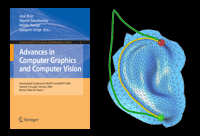
Surface
editing operations commonly require geometric details of the surface to be
preserved as much as possible. We argue that geometric detail is an intrinsic
property of a surface and that, consequently, surface editing is best performed
by operating over an intrinsic surface representation. This intrinsic
representation could be derived from differential properties of the mesh, i.e.
its Laplacian [...]
|
|
|
|
|
|
[theses.]
|
|
|
PhD
thesis: Interfaces and Algorithms for the Creation, Modification, and
Optimization of Surface Meshes (oct 2007)
|
|
my
phd thesis summarizes my work on sketch based mesh editing and creation,
as well as some work on mesh smoothing and triangle shape optimization.
all proposed algorithms are based on discrete Laplace operators and
least squares solvers. the thesis summarizes four of my previous
publications, but also gives some more insight into various
design decisions and mathematical subtleties.
|
|
|
|
|
|
|
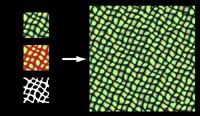
MSc
thesis: hybrid texture synthesis (june 2003)
|
|
my
masters thesis topic was the development of a novel, hybrid texture synthesis
algorithm, which combines the strengths of existing pixel- and patch-based
synthesis methods. the thesis is partially summarized in our egsr 2003 paper
above, but also contains a more detailed description of the core algorithm. We
furthermore explore efficiency enhancement and an augmented error metric, both
listed as future work in the paper.
|
|
thesis (10.3mb, pdf)
|
|
matlab code (requires matlab
6.1 with image processing toolkit)
|
|
|
|
|
[reports.]
|
|
|
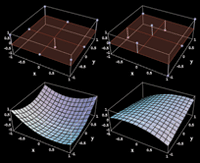
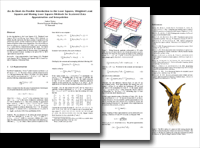
An
As-Short-As-Possible Introduction to the Least Squares, Weighted Least Squares
and Moving Least Squares Methods for Scattered Data Approximation and
Interpolation (may 2004)
|
|
In this
introduction to the Least Squares (LS), Weighted Least Squares (WLS) and Moving
Least Squares (MLS) methods, we briefly describe and derive the linear systems
of equations for the global least squares, and the weighted, local least
squares approximation of function values from scattered data. By scattered data
we mean an arbitrary set of points in d dimensional space which carry scalar
quantities (i.e. a scalar field in d dimensional parameter space). In contrast
to the global nature of the least-squares fit, the weighted, local
approximation is computed either at discrete points, or continuously over the
parameter domain, resulting in the global WLS or MLS approximation
respectively.
report (290kb, pdf)
|
|
some links
Homepage of David Levin
Computing and Rendering
Point-Set Surfaces
Surface
Approximation from Points
Defining
Point-Set Surfaces
Interpolating
and Approximating Implicit Surfaces
Meshless
Methods: An Overview and Recent Developments
Homepage of Holger
Wendland
|
|
|
|
|
|
|
|
| |


